
What Is Modeling in AAC?
And What Does “Modeling Without Expectation” Actually Mean?
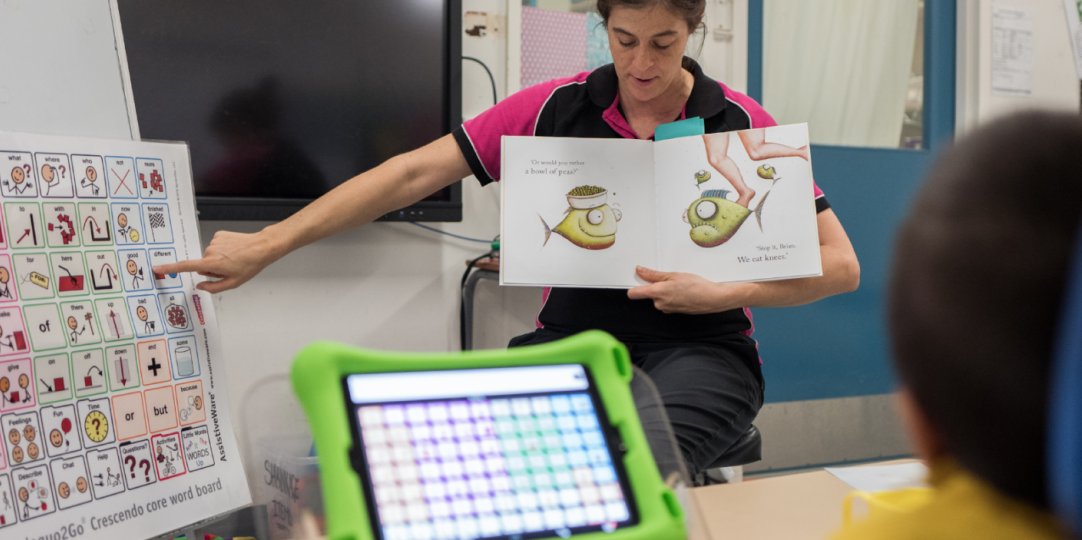
If you’ve been introduced to AAC, you’ve probably heard the phrase
“modeling without expectation.”
It’s often repeated—but rarely explained.
Parents and educators are left wondering:
- Am I doing this right?
- Should I wait for my child to respond?
- Am I supposed to correct them?
- If they don’t use AAC back, is it working?
Let’s slow this down and make it human.
First: What Is Modeling?
Modeling simply means showing how AAC is used during real life—the same way we naturally model spoken language.
When you talk to a child, you don’t:
- Quiz them
- Demand they repeat you
- Stop talking until they answer
You just… talk.
Modeling AAC is the same idea. You:
- Use the device or system
- During everyday activities
- While speaking naturally
You are showing, not testing.
What Modeling Looks Like in Real Life
Modeling is simple and brief. It does not require full sentences or perfect navigation.
Examples:
- During snack: you tap “eat” or “more” while saying the word
- During play: you model “go,” “stop,” “fun,” or “again”
- During a tough moment: you model “help,” “all done,” or “break”
You’re not asking your child to use AAC.
You’re showing them how you would use it.
So What Does “Modeling Without Expectation” Mean?
This part matters.
Modeling without expectation means:
- You are not waiting for your child to respond
- You are not requiring imitation
- You are not withholding items until AAC is used
- You are not correcting or prompting a “better” response
Your child does not need to:
- Touch the device
- Look at the device
- Copy what you did
- Acknowledge the model
And it still counts.
What Modeling Without Expectation Feels Like (For Adults)
For adults, modeling without expectation can feel:
- Awkward
- One-sided
- Slow
- Uncertain
You might think:
- “They’re not using it back.”
- “Am I wasting time?”
- “Should I be doing more?”
This is where many people stop.
But language learning has never been immediate.
Children hear thousands of spoken words before they ever say their first one. AAC is no different.
What Modeling Without Expectation Feels Like (For Children)
For children, modeling without expectation feels:
- Safe
- Predictable
- Pressure-free
- Accessible
There is no demand.
No “say it.”
No test to pass.
This is where learning actually happens.
What Modeling Is NOT
Let’s clear up some common misconceptions.
Modeling is not:
- Quizzing (“What button do you press?”)
- Prompting every time (“Use your AAC”)
- Correcting (“No, say it this way”)
- Waiting silently until the child responds
- Withholding access until AAC is used
Those strategies increase pressure—and pressure shuts communication down.
Why Modeling Works (Even When You Don’t See It)
Modeling works because it:
- Builds understanding of how words connect to meaning
- Shows AAC is a valid way to communicate
- Reduces anxiety around “doing it right”
- Gives repeated exposure without demand
Language grows through exposure, not performance.
What If I Don’t Know Where the Word Is?
This is important—and freeing.
If you can’t find a word:
- Say that
- Model searching
- Keep going
Examples:
- “Hmm, I can’t find that yet.”
- “I’m still learning this too.”
- “Let’s look together.”
This is not a mistake.
This is modeling problem-solving and real communication.
Progress Doesn’t Look Like Immediate AAC Use
AAC progress might look like:
- More attention to the device
- Longer engagement
- Less frustration
- Increased attempts (spoken, gestural, or AAC)
- Using AAC later, when no one expected it
If you only look for immediate imitation, you’ll miss real growth.
A Reframe That Helps
Instead of asking:
“Am I doing AAC right?”
Try asking:
“Is communication feeling safer and more accessible?”
That’s the goal.
The Bottom Line
Modeling without expectation means:
- Showing, not testing
- Supporting, not pressuring
- Trusting learning takes time
You do not need to be perfect.
You do not need to be fast.
You do not need to be an AAC expert.
You just need to keep AAC present, available, and human.
And that is more than enough.
Need Hands on Support: Just Ask.
If AAC feels overwhelming or confusing, you don’t have to figure it out alone. With the right guidance, AAC can feel manageable, meaningful, and supportive—not stressful.
If you’d like training, coaching, or individualized support using AAC at home or school, reach out to learn how we can help. We offer family-centered guidance designed to meet you exactly where you are—no perfection required.
Bright Blooms Therapy Blog